


Trans-Atlantic Exchange Rate Report for May 11th – 15th
By: Matthew Natof, The Quinnipiac University Global Economics Research Team
Trans-Atlantic Currencies Index
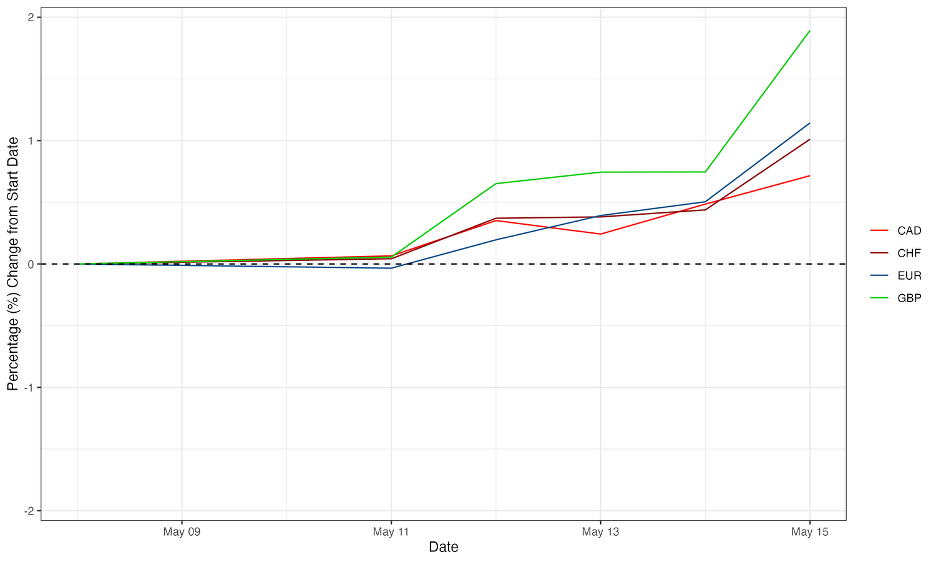
Source: Yahoo and own calculations. Exchange rates are inverted to be USD per local currency (i.e., an increase indicates a stronger domestic currency) and then indexed to be 100 at the start of the period.
From May 11th-15th, all of the Trans-Atlantic currencies ended positively. The Canadian dollar (CAD) fluctuated for the majority of the week, ending with a 0.72% increase. The Swiss franc (CHF) increases throughout the week, gaining 1.01%. The euro (EUR) was similar to the Swiss franc but ended just above with a 1.14% increase. The pound (GBP) was the outlier, surging to an increase of 1.89% for the week.
Trans-Atlantic Historical Trends

Source: Eurostat and own calculations. Exchange rates are inverted to be USD per local currency (i.e., an increase indicates a stronger domestic currency. The center line is a rolling three-month average. The upper and lower boundaries are the average plus and average minus one standard deviation, respectively, for the same three-month period.
From May 11th-15th, three of the four Trans-Atlantic currencies followed a similar contour. The Canadian dollar (CAD) depreciated the entire week, ending just below its three-month average. The Swiss franc (CHF) was similar, as it slightly decreased during the week and finished barely below its three-month average. The euro (EUR) moved similarly but finished slightly further beneath its three-month average. The British pound (GBP), the outlier, sharply depreciated at the start of the week but appreciated slightly in the latter half, ending just below the three-month average.
Additional Reading
This article explains that the British pound weakened slightly as investors reacted to political uncertainty over the UK economy. Rising inflation and government borrowing costs also pressured the currency, keeping markets cautious about the pound’s short-term outlook.


Comments