


CEE Exchange Rates Report for December 15th - 19th
By: Margaret Gachau, The Quinnipiac University Global Economics Research Team
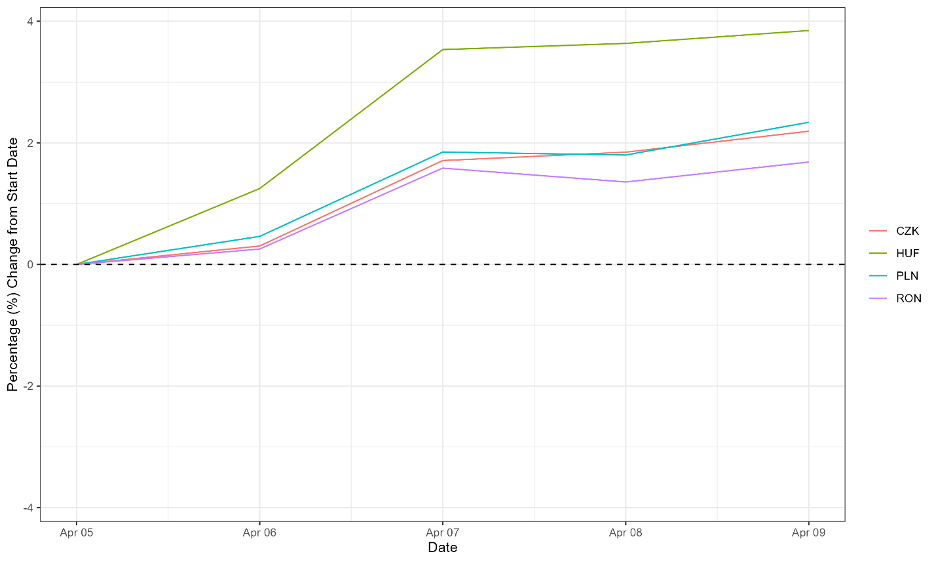
CEE Currencies Index

Source: Eurostat and own calculations. Exchange rates are inverted to be USD per local currency (i.e., an increase indicates a stronger domestic currency) and then indexed to be 100 at the start of the period.
During the week of December 15, 2025 – December 19, 2025, Central and Eastern European (CEE) currencies exhibited a pattern, marked by early-week depreciation followed by a pronounced mid-week rebound. All the four currencies initially weakened, with percentage changes slipping into negative territory, before a reversal later in the week. The Hungarian forint (green) emerged as the most volatile finishing as top performer, despite an early-week dip of roughly -0.4%. Momentum strengthened sharply mid-week, peaking at 1% and eventually ending the week, firmly positive at around 0.75 %. The Czech koruna (orange) followed a similar trajectory. After a modest early-week weakness, it rebounded steadily and closed the week at approximately 0.5%, ranking second. By contrast The Romanian leu (purple) and the Polish zloty (blue) had minimal percentage changes. Both entered the week on a softer footing but experienced a mid-week recovery. The Romanian leu ended the week at around 0.1% while the Polish zloty closed with a -0.1% change making it the weakest performer over the period.
CEE Currencies Historical Trends

Source: Eurostat and own calculations. Exchange rates are inverted to be USD per local currency (i.e., an increase indicates a stronger domestic currency. The center line is a rolling three-month average. The upper and lower boundaries are the average plus and average minus one standard deviation, respectively, for the same three-month period.
During the week of December 15, 2025 – December 19, 2025, the Central and Eastern European (CEE) currencies largely exhibited a softening followed by only limited stabilization toward the end of the week. The Polish zloty (PLN) maintained a persistent upward trajectory throughout the week. It strengthened steadily and moved decisively above its upper boundary reaching levels not observed over the past three months. The Czech koruna (CZK) softened, retreating from its upper bound and converging back toward its three-month rolling average. The Hungarian forint (HUF) displayed the highest volatility among the four currencies declining well below the upper bound approaching its three-month rolling average of approximately 0.003. Similarly, The Romanian leu (RON) weakened during the week, to drifting lower from its upper boundary.
Additional Readings
The article discusses how On December 15, 2025, the Polish zloty edged back toward a seven-month high, supported by slightly higher-revised inflation data and expectations that Poland’s central bank has limited scope for further rate cuts. Broader CEE currencies steadied after retreating from recent peaks, as markets awaited signals from upcoming Czech and Hungarian central bank meetings. With global investors cautious ahead of U.S. data, the zloty outperformed peers, while the forint and Czech koruna remained marginally firmer amid expectations that rates will stay on hold across the region.
The Polish zloty strengthened to an eight-month high in mid-December, supported by favorable year-end trading patterns, slightly higher-revised inflation data, and expectations that Poland’s central bank has limited room for further rate cuts. Improved global risk sentiment, positive equity market performance, and anticipated EU fund inflows further underpinned the currency, allowing it to break through the key EUR/PLN 4.22 resistance level. Meanwhile, other CEE currencies remained broadly steady as investors awaited guidance from upcoming Czech and Hungarian central bank meetings, with interest rates widely expected to remain on hold.


Comments