


CEE Exchange Rates Report for February 2nd – February 6th
By: Margaret Gachau, The Quinnipiac University Global Economics Research Team.
CEE Currencies Index

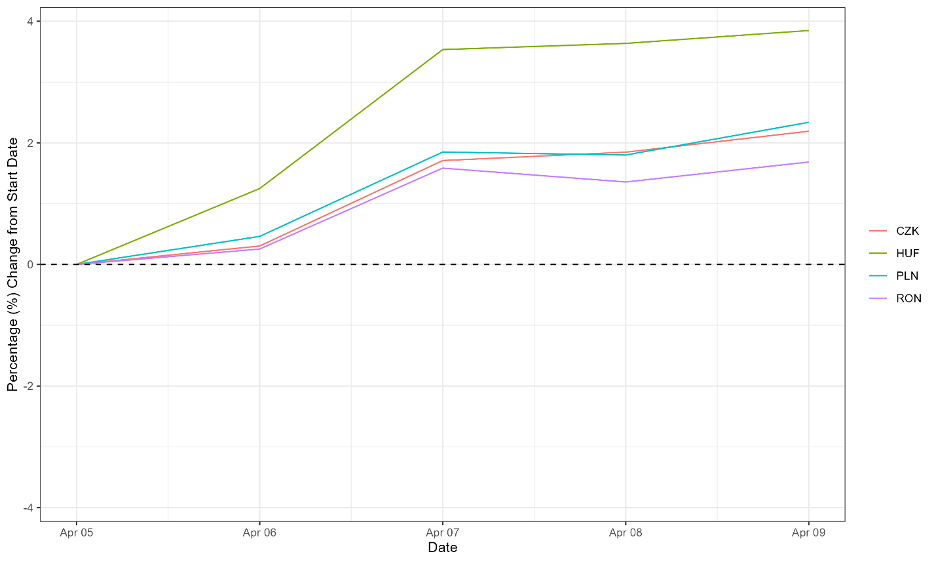
Source: Eurostat and own calculations. Exchange rates are inverted to be USD per local currency (i.e., an increase indicates a stronger domestic currency) and then indexed to be 100 at the start of the period.
During the first week of February 2026, Central and Eastern European (CEE) currencies posted broad-based appreciation against the US dollar, though with pronounced intra-week volatility. The period opened with modest gains across the region, followed by a synchronized pullback around midweek and a subsequent rebound toward the end of the week. Despite the overall positive performance, currency movements diverged in the latter part of the period. The Polish zloty (blue) and the Romanian leu (purple) emerged as the strongest performers, displaying limited late-week depreciation and closing the period with gains of approximately 1.8% and 0.9%, respectively. The Czech koruna (orange) reached a midweek high before easing slightly, finishing the week with a percentage change in exchange rate of approximately 0.6%. By contrast, the Hungarian forint (green) was the most volatile currency during the week. After appreciating to roughly 0.8% early on, the forint reversed course and weakened sharply, ending the period with a gain of approximately 0.3%.
CEE Currencies Historical Trends

Source: Eurostat and own calculations. Exchange rates are inverted to be USD per local currency (i.e., an increase indicates a stronger domestic currency. The center line is a rolling three-month average. The upper and lower boundaries are the average plus and average minus one standard deviation, respectively, for the same three-month period.
During the first week of February 2026, Central and Eastern European (CEE) currencies initially extended the short-lived depreciation observed in the previous week, briefly weakening against the U.S. dollar and moving towards their respective three-month rolling averages. Momentum shifted later in the week, as all currencies reversed course and posted modest gains. At the country level, the Czech koruna depreciated early in the week, falling to approximately 0.048 USD per koruna, before recovering and closing slightly above its three-month rolling average. A similar pattern was observed for the Hungarian forint, which weakened toward 0.00310 USD per forint before rebounding and ending the week near 0.00313. The Polish zloty also softened against the U.S. dollar early in the period, dipping below 0.280 USD per zloty, but subsequently staged a rebound, closing the week around its three-month average of approximately 0.280. Meanwhile, the Romanian leu declined to levels below its rolling average early in the period before recovering modestly, finishing the week at 0.232 USD per leu.


Comments