


CEE Exchange Rates Report for December 8th – 12th
By: Margaret Gachau, The Quinnipiac University Global Economics Research Team
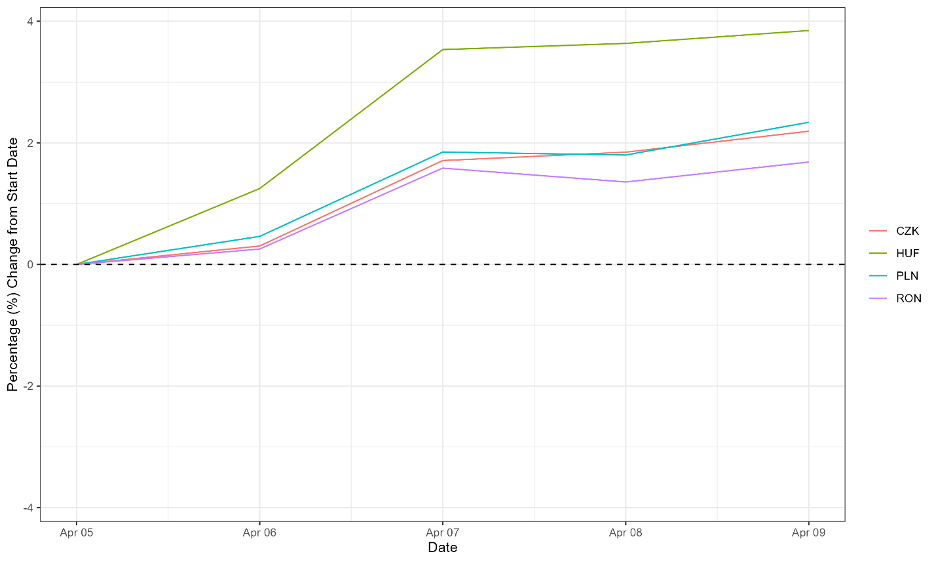
CEE Currencies Index

Source: Eurostat and own calculations. Exchange rates are inverted to be USD per local currency (i.e., an increase indicates a stronger domestic currency) and then indexed to be 100 at the start of the period.
During the week of December 8, 2025 – December 12, 2025, the percentage changes in Central and Eastern European (CEE) exchange rates displayed a general intra-week pattern, characterized by early-week appreciation followed by a mid-week reversal. All four currencies strengthened into first half of the week, with percentage changes moving into positive or near zero territory, before the momentum faded sharply after mid-week, resulting in negative changes by the end of the week. The Hungarian forint (green) was the relative performer of the week having posted early week gains peaking near 0.6% before retracting to closing the week weaker at approximately -0.1%. The Czech koruna (orange) followed a similar trajectory but experiencing a steeper pullback, ultimately ending the period at roughly -0.6%. The Romanian leu (purple) and The Polish zloty (blue) underperformed throughout the period. Both currencies entered the week with negative percentage changes, and experienced sharper late-week depreciation. The Romanian leu (purple) closed the week down approximately -0.75%, while the Polish zloty (blue) recorded the largest decline, finishing near -0.9%.
CEE Currencies Historical Trends

Source: Eurostat and own calculations. Exchange rates are inverted to be USD per local currency (i.e., an increase indicates a stronger domestic currency. The center line is a rolling three-month average. The upper and lower boundaries are the average plus and average minus one standard deviation, respectively, for the same three-month period.
During the week of December 8, 2025 – December 12, 2025, the Central and Eastern European (CEE) currencies experienced a brief early-week softening followed by a renewed recovery, extending the upward momentum observed in early December. After initial declines that brought several currencies near or back toward their rolling three-month averages, all four eventually rebounded, approaching or exceeding their upper boundary. The Czech koruna (CZK) recovered from its three-month average and appreciated steadily, approaching and briefly exceeding its upper bound hitting 0. 0485.The Hungarian forint (HUF) displayed the strongest momentum, initially depreciating below its upper boundary before rebounding sharpy to above 0.00310 slightly surpassing early December highs. The Polish zloty (PLN) followed a similar appreciation path, rising to approximately 0.0277, its highest level in the three-month period, aligning way above its upper bound. The Romanian leu (RON) also strengthened, climbing toward 0.231 and returning to its upper boundary for the first time since late October.
Additional Reading
The article notes that the Europe, the Middle East, and Africa (EMEA) currencies benefited in 2025 from a softer U.S. dollar and supportive global risk sentiment, but expects further gains to be more selective and fundamentals-driven. Within CEE, the Czech koruna is viewed as the most structurally supported, backed by strong growth, sound fiscal policy, and favorable real interest-rate differentials. The Hungarian forint remains supported by high carry but faces rising two-way risks, while the Polish zloty is expected to remain range-bound and the Romanian leu broadly stable under continued policy management.


Comments