


CEE Exchange Rates Report for January 5th - 9th
By: Margaret Gachau, The Quinnipiac University Global Economics Research Team
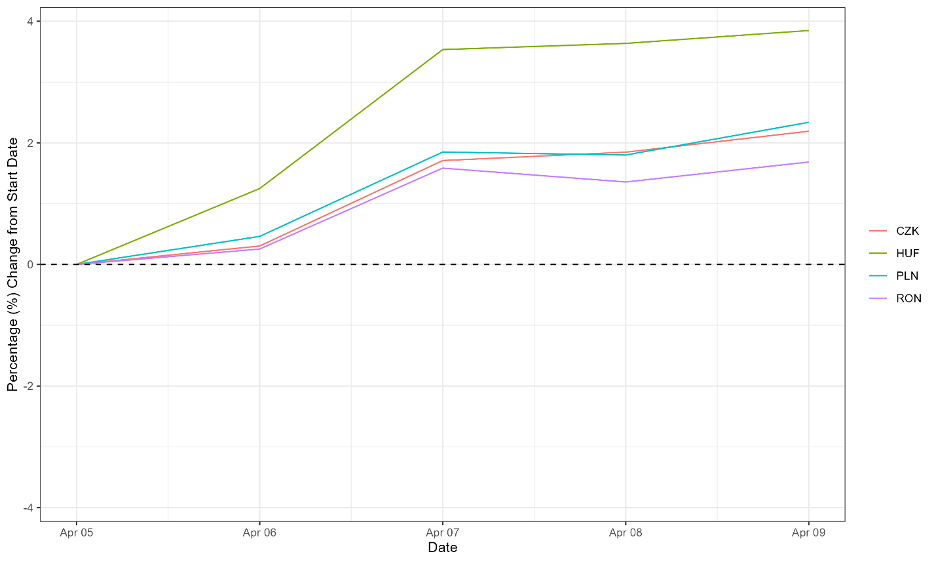
CEE Currencies Index

Source: Eurostat and own calculations. Exchange rates are inverted to be USD per local currency (i.e., an increase indicates a stronger domestic currency) and then indexed to be 100 at the start of the period.
In the week of January 5, 2026 – January 9, 2026, Central and Eastern Europe (CEE) currencies generally experienced mild early-to-mid-week weakness followed by a broad end-of-week rebound, with the Czech koruna (orange) as the notable exception. The Koruna outperformed its regional peers, strengthening steadily throughout the week, emerging as the top performer with a gain of nearly 1.5%. The Hungarian forint (green) followed closely, posting an early-week depreciation, a modest mid-week recovery and a renewed advance toward week’s end, ultimately ranking second among the currencies with an appreciation of roughly 1.3%. The Polish zloty (blue) was the most volatile, suffering a sharp mid-week depreciation before rebounding to close the week up around 0.7%. The Romanian leu (purple) underperformed relative to its peers, reaching the lowest point among the four currencies at approximately 0.3% before partially reversing course toward the end of the week. It ultimately closed with a modest gain of about 0.6%.
CEE Currencies Historical Trends

Source: Eurostat and own calculations. Exchange rates are inverted to be USD per local currency (i.e., an increase indicates a stronger domestic currency. The center line is a rolling three-month average. The upper and lower boundaries are the average plus and average minus one standard deviation, respectively, for the same three-month period.
At the start of January 2026, Central and Eastern European (CEE) currencies generally exhibited a downward adjustment, retracting from the elevated levels reached in December 2025, with the Romanian leu (RON) as the notable exception. The Czech koruna (CZK) softened, retreating from above its upper boundary and converging back toward its three-month rolling average of 0.048. The Hungarian forint (HUF) followed a similar trajectory, declining from elevated levels and moving closer to its three-month average near 0.003, after having briefly exceeded its upper bound. The Polish zloty (PLN) also depreciated against the U.S dollar at the start of the year, with the exchange rate easing to around 0.276, slightly below its upper bound. In contrast, the Romanian leu (RON) showed relative resilience: after a brief early-week weakening, it gradually strengthened toward the end of the first week of 2026, trading near 0.231, close to its upper bound.
Additional Reading
The article highlights an improving macroeconomic outlook for Central and Eastern Europe in 2026, with economic growth expected to strengthen modestly across most countries and inflation continuing to ease. Poland is projected to remain the region’s growth leader, while Hungary is expected to see a notable recovery after several years of stagnation. Declining inflation is anticipated to support further monetary easing across most CEE economies, with Czechia as the main exception where policy rates are likely to remain stable. Overall, the outlook points to relatively resilient regional fundamentals and supportive conditions for CEE currencies and bond markets in 2026.


Comments