


CEE Exchange Rates Report for January 19th – 23rd
By: Margaret Gachau, The Quinnipiac University Global Economics Research Team
CEE Currencies Index

Source: Eurostat and own calculations. Exchange rates are inverted to be USD per local currency (i.e., an increase indicates a stronger domestic currency) and then indexed to be 100 at the start of the period.
During the week of January 19, 2026 – January 23, 2026, Central and Eastern Europe (CEE)
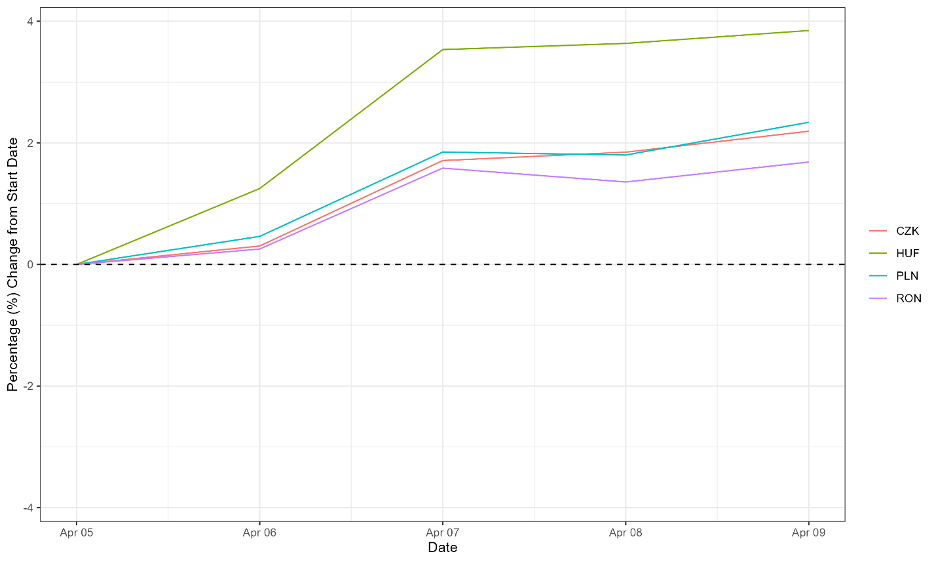
Currencies exhibited a broadly depreciative trajectory against the US dollar, punctuated by a brief midweek stabilization for some currencies. All the four registered net negative percentage changes by week’s end, though the magnitude and volatility varied. The Hungarian forint (green) was the most volatile, briefly edging up early in the week before reversing sharply, falling from around 0.1% to approximately -1.9% by end of the week. The Polish zloty (blue) and Romanian leu (purple) moved largely in near lockstep for most of the week, displaying nearly identical trajectories against the U.S. dollar. However, their paths diverged toward the end of the period: the leu experienced a late-week, temporary appreciation before closing the week at -1.0%, while the zloty continued to depreciate, ending weaker at approximately -1.5%. The Czech koruna (orange) also followed the broader regional pattern, recording an early decline, a brief midweek stabilization, and renewed depreciation toward the end of the week, ultimately closing at around -1.2%.
CEE Currencies Historical Trends

Source: Eurostat and own calculations. Exchange rates are inverted to be USD per local currency (i.e., an increase indicates a stronger domestic currency. The center line is a rolling three-month average. The upper and lower boundaries are the average plus and average minus one standard deviation, respectively, for the same three-month period.
In the third week of January 2026, Central and Eastern European (CEE) currencies recorded a sharp reversal from the previous week’s depreciation, staging broad-based appreciations against the U.S. dollar. All currencies strengthened decisively, breaking above their respective three-month rolling averages and reaching levels not observed over the prior two months, with exchange rates pushing above their upper volatility bands. Minor midweek depreciations were observed across the region; however, these moves were short-lived and were quickly reversed by renewed appreciation toward the end of the week. At the country level, the Czech koruna (CZK) strengthened to a peak of approximately 0.0486, while the Hungarian forint (HUF) rose to just under 0.0031. The Polish zloty (PLN) advanced to around 0.280, and the Romanian leu (RON) outperformed on a relative basis, reaching levels above 0.232.
Additional Reading
Central European assets strengthened after U.S. President Donald Trump stepped back from threats to impose new tariffs on European allies in connection with negotiations over Greenland. The de-escalation eased fears of a broader EU–U.S. trade conflict, boosting investor risk appetite across the region. Equity markets rallied, while CEE currencies firmed, with the Polish zloty and Hungarian forint extending gains amid improved sentiment. Analysts noted that calmer U.S. rhetoric reduced geopolitical risk premia, supporting regional currencies and reinforcing the late-week appreciation observed across CEE FX markets.


Comments