


CEE Exchange Rates Report for November 24th – 28th
By: Margaret Gachau, The Quinnipiac University Global Economics Research Team
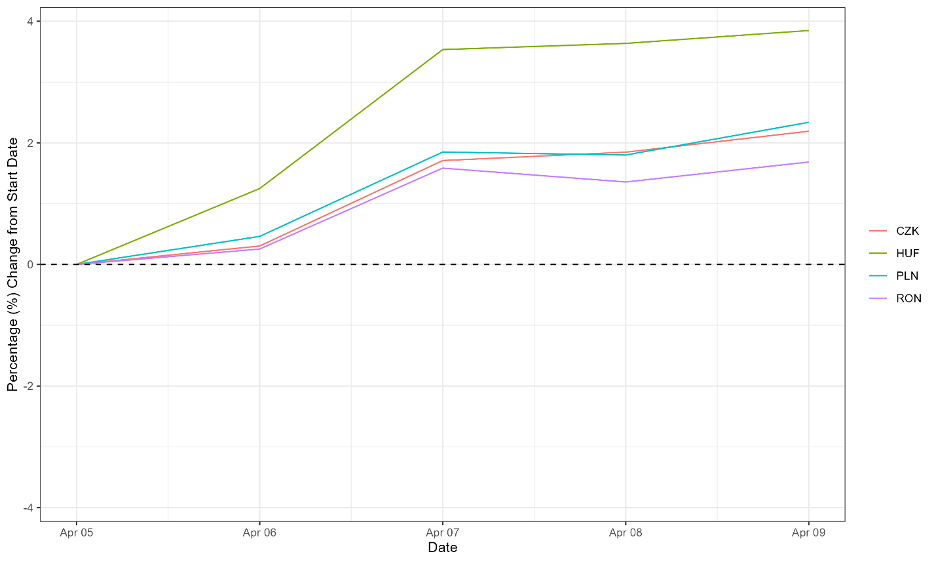
CEE Currencies Index

Source: Eurostat and own calculations. Exchange rates are inverted to be USD per local currency (i.e., an increase indicates a stronger domestic currency) and then indexed to be 100 at the start of the period.
During the week of November 24, 2025 – November 28, 2025, the CEE currencies recorded broad but uneven depreciation against the U.S dollar. Although all currencies fell over the first four days of the period, the degree of weakness and the pace of late-week stabilization varied across currencies. The Romanian leu (purple) proved the most resilient posting mild depreciation throughout the week and began to recover as the week ended, finishing as the strongest performer among the four currencies. The Polish zloty (blue) weakened steadily through mid-week rebounding modestly, by roughly 0.25% leaving it as the second strongest performer of the week. The Czech koruna (orange) also followed a general downward trajectory with its depreciation persisting through November 27th, before showing a slight improvement on the final trading day. The Hungarian forint (green) exhibited the largest fluctuations. After an early and mid-week slide, the currency remained on a weaker path overall, ending the week with nearly -0.9%, making it the weakest performer of the group.
CEE Currencies Historical Trends

Source: Eurostat and own calculations. Exchange rates are inverted to be USD per local currency (i.e., an increase indicates a stronger domestic currency. The center line is a rolling three-month average. The upper and lower boundaries are the average plus and average minus one standard deviation, respectively, for the same three-month period.
Toward the end of November, CEE currencies showed a recovery trend after a period of weakness in the previous week. Although the degree of strengthening varied across currencies, all four moved closer to, or above, their respective rolling three-month average. The Czech koruna (CZK) showed a clear appreciation, rising above its 0.048 rolling three-month average marking a reversal of the earlier November depreciation. The Hungarian forint (HUF) followed a similar constructive pattern, it strengthened notably toward the end of the period, approaching levels comparable to those recorded in September. The Polish zloty (PLN) also improved, climbing back above its rolling three-month average offsetting earlier declines. Meanwhile, the Romanian leu (RON) also firmed slightly. By the end of November, it was trading just above its lower boundary, an improvement relative to some earlier weeks, though still weaker compared to its regional peers.
Additional Readings
The report shows that late-November exchange movements across the CEE region were influenced by a combination of improving geopolitical sentiment, falling European energy prices, and expectations of a softer U.S. Federal Reserve stance. Early optimism around Ukraine peace talks reduced regional risk premiums, helping CEE currencies stabilize after mid-week weakness.
This article highlights and compares November’s top performers, Czechia and Hungary. It provides useful background information on how differences in their monetary and fiscal policies have shaped the two countries’ recovery paths over the past five years.


Comments