


CEE Exchange Rates Report for April 13th – April 17th
By: Margaret Gachau, The Quinnipiac University Global Economics Research Team
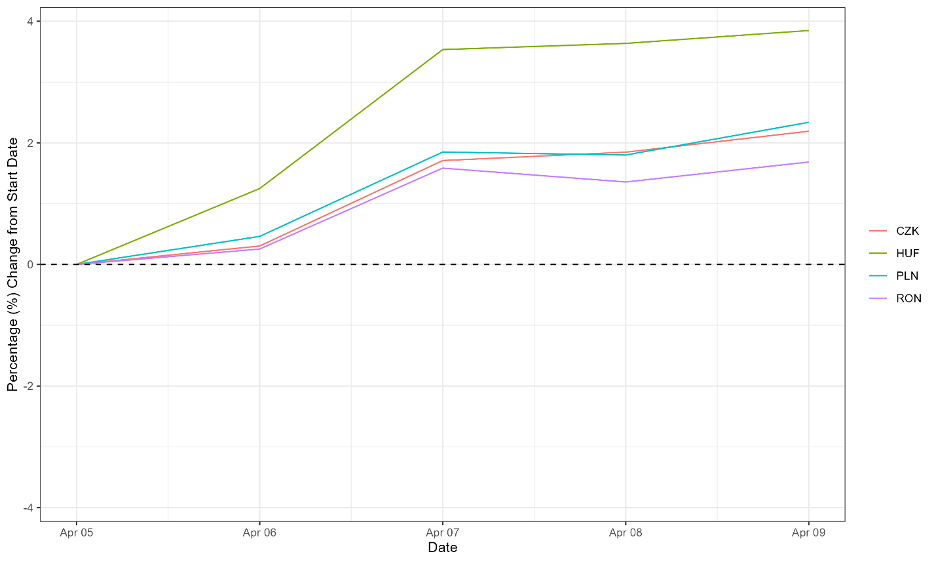
CEE Currencies Index

Source: Eurostat and own calculations. Exchange rates are inverted to be USD per local currency (i.e., an increase indicates a stronger domestic currency) and then indexed to be 100 at the start of the period.
During the week of April 13–17, 2026, Central and Eastern European (CEE) currencies generally recorded negative percentage changes against the U.S. dollar, reversing early gains and moving below the baseline by midweek. The Hungarian forint (Green) was the clear underperformer, experiencing a sharp and sustained depreciation. It declined steeply through midweek, reaching a low of around -4%, and despite a slight recovery, remained significantly weaker by the end of the period. The Polish zloty (Blue) and Czech koruna (Red) followed similar but more moderate downward trajectories. Both currencies posted positive percentage changes in exchange rates early in the week, dipped around midweek, and continued to weaken into negative territory. By the end of the week, they remained below zero, both closing at approximately -1.2%. The Romanian leu (Purple) moved largely in line with the zloty and koruna, but showed relatively greater stability. Although it also fell below the baseline after midweek, its fluctuations were less pronounced, and it ended the week with a smaller decline of around-1.1%.
CEE Currencies Historical Trends

Source: Eurostat and own calculations. Exchange rates are inverted to be USD per local currency (i.e., an increase indicates a stronger domestic currency. The center line is a rolling three-month average. The upper and lower boundaries are the average plus and average minus one standard deviation, respectively, for the same three-month period
During the week of April 13–17, 2026, Central and Eastern European (CEE) currencies exhibited a mixed but generally strengthening pattern against the U.S. dollar, with most currencies continuing to rebound from earlier slight declines and moving back toward or above their three-month rolling averages by the end of the week. At currency level, the Czech koruna (CZK) showed a gradual recovery, rising from below its recent range early in the week and trending upward to approach its upper bound of approximately 0.048. The Hungarian forint (HUF) demonstrated the strongest upward momentum, rebounding sharply from midweek lows and climbing to finish near the upper end of its range around 0.0032. The Polish zloty (PLN) followed a steady upward trajectory, recovering from its earlier dip and moving back toward its upper bound of approximately 0.278 by the end of the week. Meanwhile, the Romanian leu (RON) also experienced a moderate recovery. After declining midweek, it rebounded before slightly nosediving to end the period, slightly above its three-month rolling average of around 0.230.
Additional Reading
The Reuters report from April 13, 2026, highlights that the Hungarian forint surged to near multi-year highs following the unexpected electoral defeat of long-time Prime Minister Viktor Orbán. Investors reacted positively to the outcome, anticipating improved relations with the European Union and the potential release of approximately €18 billion in previously frozen EU funds. The incoming leadership under Peter Magyar, viewed as more pro-European, has also signaled a commitment to economic reforms aligned with euro adoption criteria, including lowering inflation targets. This shift in political direction boosted investor confidence, driving gains in Hungary’s currency, bonds, and equities.


Comments