


CEE Exchange Rates Report for April 20th – April 24th
By: Margaret Gachau, The Quinnipiac University Global Economics Research Team.
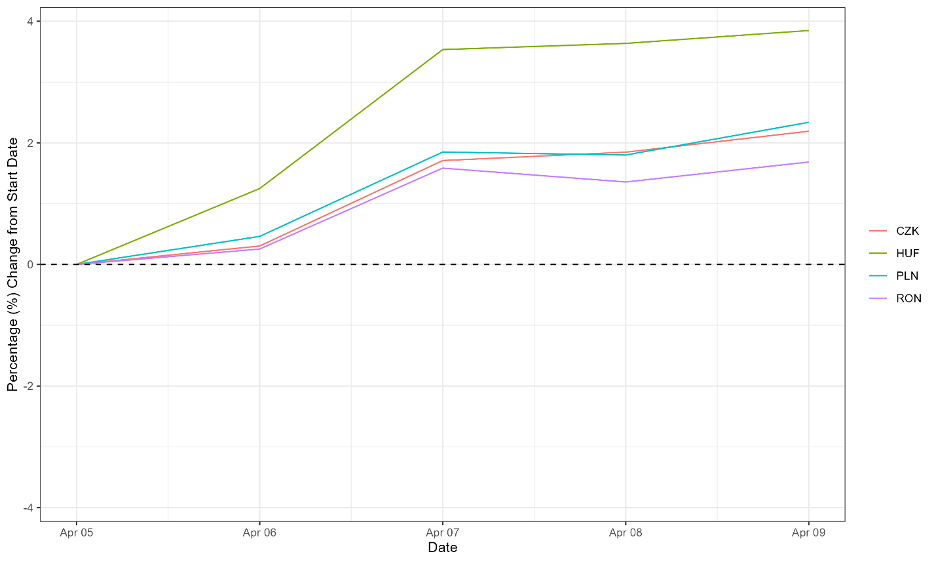
CEE Currencies Index

Source: Eurostat and own calculations. Exchange rates are inverted to be USD per local currency (i.e., an increase indicates a stronger domestic currency) and then indexed to be 100 at the start of the period.
During the week of April 20–24, 2026, Central and Eastern European (CEE) currencies recorded consistent positive percentage changes against the U.S. dollar, reversing start of the week weakness and maintaining an upward trajectory most of the period with slight declines towards the end. The Hungarian forint (Green) emerged as the strongest performer, showing a sharp and sustained appreciation. After modest gains early in the week, it surged significantly from midweek onward, reaching the highest level among the group at 1.5% by the end of the period. The Polish zloty (Blue) and Czech koruna (Red) followed similar upward paths, with steady gains early in the week and a more pronounced increase after midweek. Both currencies peaked around April 23, with the zloty slightly outperforming the koruna, before stabilizing marginally lower by the end of the week, closing near 0.9% and1.0% respectively. The Romanian leu (Purple) also appreciated over the period but remained the most stable among the group. Its upward movement was more gradual, with smaller fluctuations, and it ended the week with a moderate gain of approximately 0.6%.
CEE Currencies Historical Trends

Source: Eurostat and own calculations. Exchange rates are inverted to be USD per local currency (i.e., an increase indicates a stronger domestic currency. The center line is a rolling three-month average. The upper and lower boundaries are the average plus and average minus one standard deviation, respectively, for the same three-month period
During the week of April 20–24, 2026, Central and Eastern European (CEE) currencies exhibited notable fluctuations against the U.S. dollar, with most depreciating at the start of the week before recovering modestly toward the end of the period. Overall, the trend reflects a late-week rebound following earlier volatility. At the currency level, the Czech koruna (CZK) showed a moderate recovery. After dipping slightly below its three-month rolling average early in the week, it trended upward toward the end, stabilizing and above its average of 0.048. The Hungarian forint (HUF) recorded the strongest performance, rebounding slightly from midweek lows. It remained decisively above its upper bound, ending the week around 0.0032, signaling strong upward momentum. The Polish zloty (PLN) followed a steady recovery path, climbing from earlier lows and moving back toward its rolling average. By the end of the week, it stabilized slightly above its three-month average, near 0.276. Meanwhile, the Romanian leu (RON) also demonstrated a gradual recovery. After reaching a trough midweek, it rebounded and moved back slightly above its three-month rolling average, ending the period around 0.230.
Additional Reading
The report highlights that Recent geopolitical developments in the Middle East, particularly the fragile ceasefire and repeated disruptions to the Strait of Hormuz, have continued to influence economic conditions in Central and Eastern Europe (CEE). While the initial ceasefire led to a sharp drop in oil prices, energy costs remain elevated at around USD 90–100 per barrel—levels that are still inflationary. As a result, inflation expectations across the CEE region have been revised upward, now averaging 3.8% for 2026, compared to earlier forecasts of 3.2%. At the same time, growth projections have been slightly downgraded, reflecting the lingering impact of higher energy costs and ongoing uncertainty, with Romania facing the most pronounced slowdown due to additional domestic fiscal pressures.


Comments