


CEE Exchange Rates Report for March 23rd – March 27th
By: Margaret Gachau, The Quinnipiac University Global Economics Research Team.
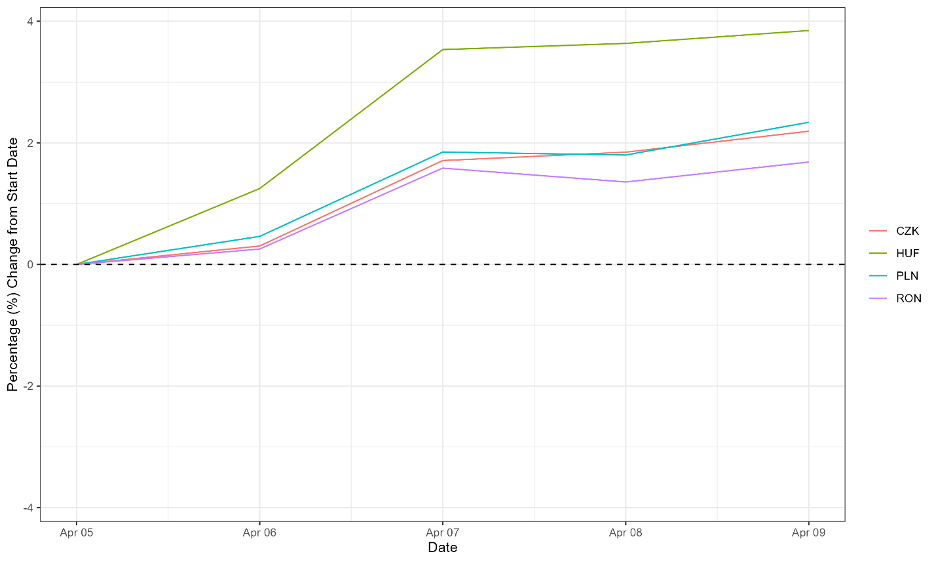
CEE Currencies Index

Source: Eurostat and own calculations. Exchange rates are inverted to be USD per local currency (i.e., an increase indicates a stronger domestic currency) and then indexed to be 100 at the start of the period.
During the week shown, Central and Eastern European (CEE) currencies generally weakened early on, followed by a midweek recovery and a stronger rebound toward the end of the period. The Hungarian forint (green) was again the most volatile, dropping sharply to around -1.3% before partially recovering, though it remained in negative territory by the end at roughly -0.4%. The Polish zloty (blue) and Czech koruna (red) followed similar trajectories, both declining to about -0.6% to -0.7% early in the week, recovering midweek, dipping again, and then strengthening into positive territory by the end, closing near 0.5% and 0.45%, respectively. In contrast, the Romanian leu (purple) showed comparatively less volatility, remaining closer to zero throughout, dipping modestly midweek, and ultimately ending slightly positive at around 0.35%. Overall, most currencies recovered and closed stronger, with the exception of the forint, which lagged behind its regional peers.
CEE Currencies Historical Trends

Source: Eurostat and own calculations. Exchange rates are inverted to be USD per local currency (i.e., an increase indicates a stronger domestic currency. The center line is a rolling three-month average. The upper and lower boundaries are the average plus and average minus one standard deviation, respectively, for the same three-month period
During the most recent period shown, Central and Eastern European (CEE) currencies exhibited a clear downward shift against the U.S. dollar, with most currencies breaking below their recent average ranges. The Czech koruna (CZK) trended downward toward the end of the period, falling below its lower bound, indicating sustained weakening pressure. The Hungarian forint (HUF) dropped abruptly after a period of relative stability and remaining well below both its average and lower bound. Similarly, the Polish zloty (PLN) experienced a pronounced drop, briefly stabilizing but ultimately remaining below its lower bound by the end of the period. The Romanian leu (RON) followed a more gradual downward path, with less volatility but a consistent decline that placed it below both its rolling average and lower bound. Overall, the trend suggests broad-based depreciation across CEE currencies.
Additional Reading
The article highlights that CEE currencies, particularly the Hungarian forint (HUF) and Polish zloty (PLN), have remained relatively resilient despite ongoing geopolitical tensions, largely supported by high real interest rates and strong liquidity conditions. However, this resilience may be tested as underlying fundamentals weaken, including pressures from energy costs, labor market dynamics, and fiscal risks. The report notes that while current real rate buffers (around 300–400 basis points) have helped limit capital outflows, they may represent only a minimum threshold, especially as Western Europe moves toward more aggressive rate hikes. This could force CEE central banks to adjust policy more quickly to maintain currency stability. In contrast, the Romanian leu (RON) and Czech koruna (CZK) continue to underperform, partly due to lower real rates and weaker carry attractiveness. Overall, while high yields have supported CEE currencies in the short term, growing macroeconomic and policy risks suggest that this support may not be sustained if external pressures intensify.
The article reports that Central and Eastern European currencies weakened at the start of the week as escalating tensions in the Middle East increased global risk aversion and boosted demand for the U.S. dollar. The Polish zloty, Czech koruna, and Hungarian forint all depreciated amid a stronger dollar and declining investor sentiment. Rising energy price risks and uncertainty around the Strait of Hormuz further intensified pressure on the region, given its reliance on energy imports. At the same time, central bank expectations, particularly the likelihood of the Hungarian central bank holding rates steady despite inflation pressures, highlighted the difficult policy trade-offs facing the region. Overall, the article underscores how external geopolitical shocks and energy market uncertainty weighed on CEE currencies, especially early in the week.


Comments