


CEE Exchange Rates Report for April 6th – April 9th
By: Margaret Gachau, The Quinnipiac University Global Economics Research Team.
CEE Currencies Index
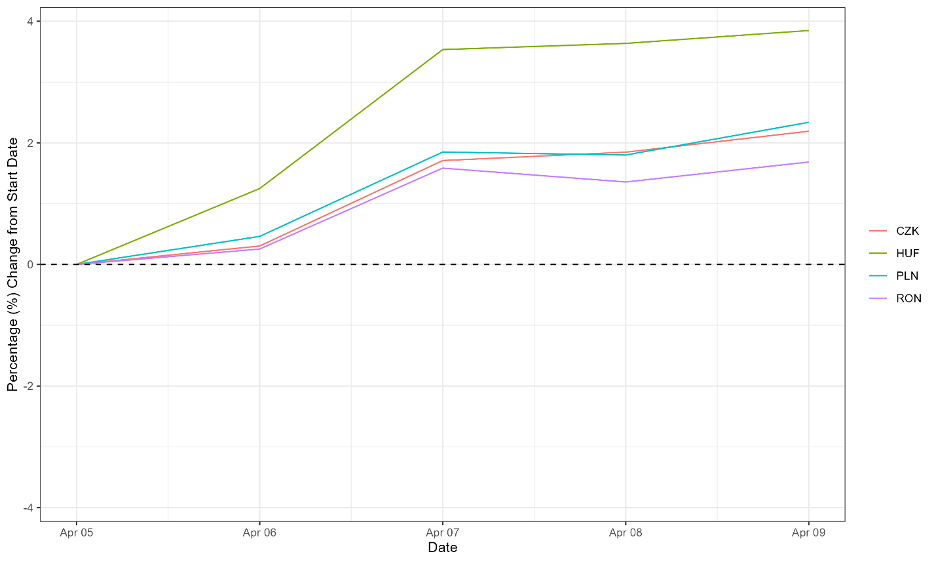
Source: Eurostat and own calculations. Exchange rates are inverted to be USD per local currency (i.e., an increase indicates a stronger domestic currency) and then indexed to be 100 at the start of the period.
In the week of April 6, 2026 – April 10, 2026 (Friday excluded) , Central and Eastern European (CEE) currencies generally strengthened against the U.S. dollar, with gains building steadily over the period. The Hungarian forint (green) was the standout performer, showing the strongest and most consistent appreciation, rising sharply early in the week and continuing its upward trend to close at nearly 4%. The Polish zloty (blue) and Czech koruna (red) followed similar paths, both posting moderate gains. They climbed steadily through midweek, experienced a slight pause in momentum, and then resumed strengthening toward the end of the period, closing at around 2.3% and 2.2%, respectively. In contrast, the Romanian leu (purple) exhibited more modest movement. While it followed the general upward trend, its gains were smaller and slightly uneven, including a mild dip midweek before recovering to end at approximately 1.6% change in exchange rate.
CEE Currencies Historical Trends

Source: Eurostat and own calculations. Exchange rates are inverted to be USD per local currency (i.e., an increase indicates a stronger domestic currency. The center line is a rolling three-month average. The upper and lower boundaries are the average plus and average minus one standard deviation, respectively, for the same three-month period
During the week of April 6 - April 10, 2026, Central and Eastern European (CEE) currencies exhibited an overall recovery against the U.S. dollar, following earlier downward pressure. Most currencies moved from below their recent ranges and strengthened toward their respective three-month rolling averages by the end of the week. The Czech koruna (CZK) showed a clear upward trend toward the end of the period, recovering to slightly above its three-month average of approximately 0.048. Similarly, the Hungarian forint (HUF) rebounded from its lower bound and strengthened notably, finishing the week near its upper range around 0.0032, reflecting a strong recovery. The Polish zloty (PLN) also followed a recovery pattern, rising steadily and stabilizing close to its three-month average of around 0.276 by the end of the week. Meanwhile, the Romanian leu (RON) exhibited a more gradual upward movement. Although it experienced a slight dip midweek, it recovered and ended the period above its three-month rolling average of approximately 0.230.
Additional Reading
The article highlights that Recent movements in Central and Eastern European (CEE) currencies can largely be explained by external macroeconomic pressures, particularly fluctuations in global energy prices and shifts in investor sentiment. CEE economies are highly dependent on energy imports, making their currencies sensitive to oil price volatility, which affects trade balances, inflation, and monetary policy responses. Periods of rising geopolitical uncertainty, especially in energy markets, tend to strengthen the U.S. dollar as a safe-haven asset, placing downward pressure on CEE currencies early in the week. As conditions stabilize or expectations around monetary policy improve, these currencies often recover, reflecting renewed investor confidence and regional economic resilience. Overall, the observed currency movements reflect a combination of global risk dynamics, energy price shocks, and differing levels of structural vulnerability across CEE economies, with the Hungarian forint typically showing the highest sensitivity.


Comments