


CEE Exchange Rates Report for March 16th – March 20th
By: Margaret Gachau, The Quinnipiac University Global Economics Research Team.
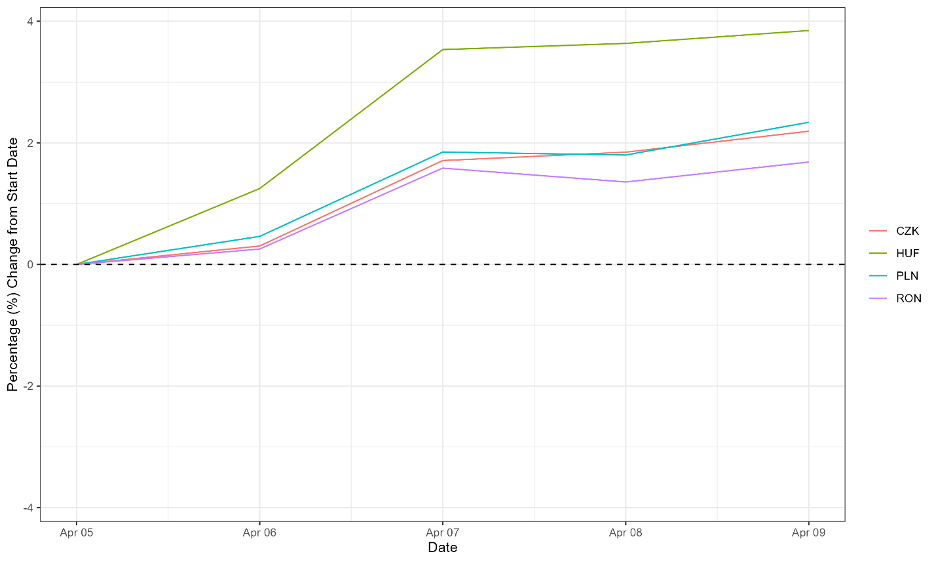
CEE Currencies Index

Source: Eurostat and own calculations. Exchange rates are inverted to be USD per local currency (i.e., an increase indicates a stronger domestic currency) and then indexed to be 100 at the start of the period.
During the week of March 16–20, 2025, Central and Eastern European (CEE) currencies exhibited broadly negative percentage changes early in the week, followed by a partial recovery that faded toward the end of the period. The Hungarian forint (green) was the most volatile, declining steadily before a sharp early week drop to around -1.3%, the largest depreciation among the group. It then rebounded into positive territory near 0.6% before easing slightly by week’s close. The Polish zloty (blue) followed a similar pattern, falling to approximately -0.7%, recovering to around 0.3%, and ultimately ending slightly negative. Likewise, the Czech koruna (red) declined to about -0.5% mid-week, rebounded modestly to around 0.2%, and closed near -0.4%. In contrast, the Romanian leu (purple) remained the weakest performer, maintaining negative territory throughout the week. Despite a brief recovery, it ended at approximately -0.7%, lagging behind its regional peers, which generally closed around -0.4%.
CEE Currencies Historical Trends

Source: Eurostat and own calculations. Exchange rates are inverted to be USD per local currency (i.e., an increase indicates a stronger domestic currency. The center line is a rolling three-month average. The upper and lower boundaries are the average plus and average minus one standard deviation, respectively, for the same three-month period
During the week of March 16–20, 2025, Central and Eastern European (CEE) currencies continued to weaken against the U.S. dollar, extending the softer trend observed earlier in the month. At the country level, the Czech koruna (CZK) showed a steady decline toward the end of the week, closing near 0.047 USD per koruna, below its recent average range. The Hungarian forint (HUF) exhibited the most reversal. Despite trading near weak levels earlier in the week, it gained momentum and improved significantly, ending the week at around 0.0029 USD per forint, but clearly below both its rolling average and lower bound. Similarly, the Polish zloty (PLN) weakened early in the weekly but strengthened in the final trading days, closing near 0.269 USD per zloty, below its lower bound range. The Romanian leu (RON) followed the same trajectory, with a gradual strengthening that slightly reversed toward the end of the week. It closed at approximately 0.225 USD per leu, positioning it just below both its rolling average and lower bound.
Additional Reading

The article explains that Reuters poll suggests that while Central and Eastern European (CEE) currencies have recently reached multi-year highs, their upward momentum may be limited going forward. The Hungarian forint is expected to weaken the most, with forecasts pointing to a gradual decline driven by potential interest rate cuts, political uncertainty ahead of elections, and weaker economic performance linked to delayed EU funds. In contrast, the Czech koruna and Polish zloty are expected to remain relatively stable or strengthen slightly, supported by stronger economic fundamentals, favorable trade balances, and interest rate differentials. Meanwhile, the Romanian leu is projected to depreciate modestly due to persistent fiscal pressures, particularly a high budget deficit, although recent improvements in budget execution provide some support.
Overall, while CEE currencies have benefited from strong policy settings and recovery trends, analysts expect limited further appreciation and some mild depreciation risks in the near term.


Comments